
In 2026, the question for small businesses is no longer if you should market digitally, but how precisely you can engineer your Customer Acquisition Cost (CAC). With the total eclipse of third-party cookies and the rise of Generative Engine Optimization (GEO), digital marketing has evolved from a discretionary expense into a high-yield investment.
According to the Gartner 2025 CMO Report, marketing budgets have settled at a resilient 7.7% of total revenue, yet the internal composition of those budgets has shifted. Digital channels now command 68% of the total spend, driven by a 15% increase in AI-integrated advertising efficiency. For the modern small business, “budgeting” is now a technical exercise in balancing immediate lead generation with the long-term compounding interest of brand authority.
1. The “Golden Rule” Percentages
While every business is unique, the general consensus for 2026 revolves around your current revenue and growth goals. According to the Gartner 2025 CMO Spend Survey, average marketing budgets have stabilized at approximately 7.7% of total company revenue.
| Business Stage | % of Gross Revenue | Strategic Objective |
| Maintenance | 5% – 8% | Maintain steady traffic; sustain current Customer Acquisition Cost (CAC). |
| Active Growth | 9% – 12% | Capture new market share; outpace local competitors through aggressive SEO/AEO. |
| Aggressive Scaling | 15% – 20%+ | High-velocity acquisition; typical for startups or new product launches. |
The 2026 Shift: Digital channels now account for over 68% of total global ad spend (Dentsu 2026 Forecast). For many small businesses, your “digital” budget is effectively your entire marketing budget.
2. Industry Benchmarks & Unit Economics
Where you play determines how much you pay. In 2026, the focus has shifted from “spending” to LTV:CAC ratios (Lifetime Value to Customer Acquisition Cost). A healthy benchmark is 3:1—meaning you earn $3 for every $1 spent on acquisition.
- SaaS & Tech (8% – 20%): High focus on acquisition. Average B2B SaaS CAC in 2026 is approximately $1,200, though self-serve models can be as low as $200 (SaaSHero 2026).
- Retail & E-commerce (15% – 25%): Hyper-competitive. However, e-commerce enjoys the lowest CAC, often ranging from $80 – $130 (Usermaven).
- Professional Services (7% – 10%): Heavy focus on Answer Engine Optimization (AEO) and thought leadership to combat the 25% drop in traditional search volume (Gartner).
- Manufacturing/B2B (2% – 8%): Longer sales cycles; focus on CRM integration and account-based marketing (ABM).
3. The 70-20-10 Rule: Advanced Allocation
In 2026, the “Lab” isn’t just a luxury; it’s a survival tactic against AI disruption.
- 70% (The Foundation): Invest in “proven” channels with established ROI.
- Example: Email Marketing continues to be the ROI king, returning roughly $36 for every $1 spent (ALM Corp).
- 20% (The Expansion): Fund emerging opportunities.
- Example: Video Marketing and Creator-led content. 59% of consumers are now more likely to buy products recommended by their favorite influencer (Nielsen).
- 10% (The Lab): Experimental tactics.
- Example: Testing AI Agents for autonomous customer interaction or predictive demand forecasting.
4. Technical Breakdown: Where the Money Goes
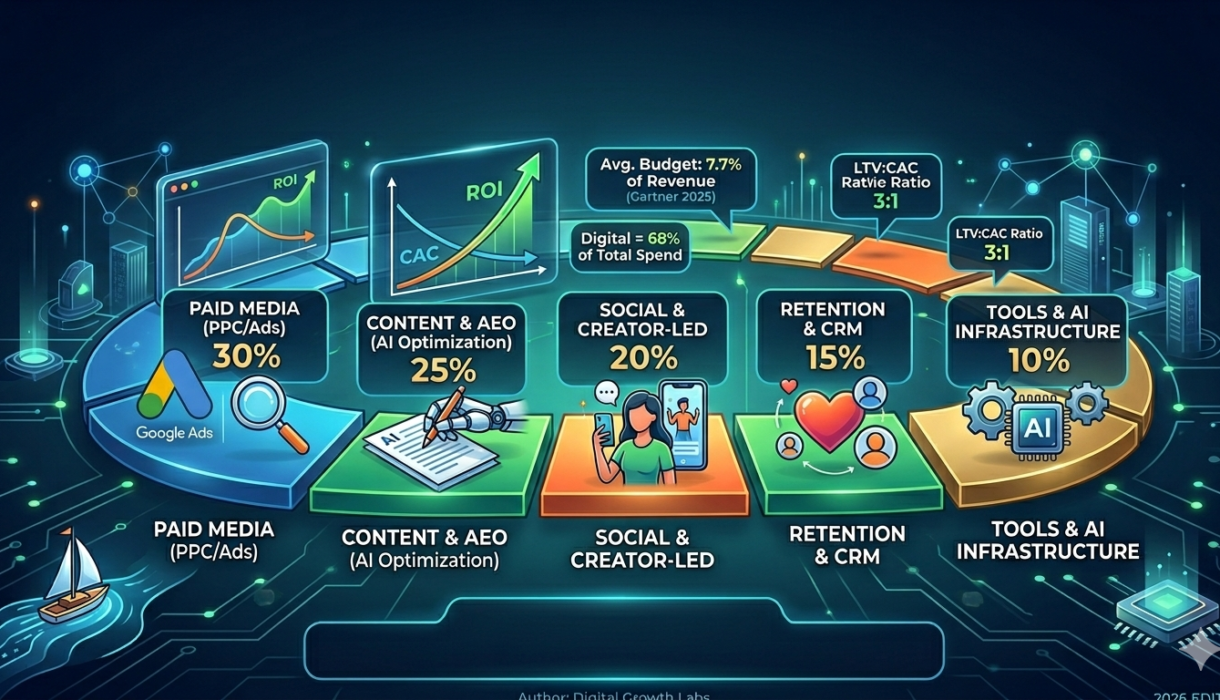
If you are spending $2,500 to $5,000 per month, here is a typical 2026 allocation based on efficiency gains from Generative AI:
Paid Media (30% of spend)
Focus on PPC and Paid Social. AI-powered PPC campaigns now demonstrate 50% higher click-through rates (CTR) and 30% better conversion rates than traditional manual setups (Premiere Creative).
Content & AEO (25% of spend)
Investing in AI-assisted content. 84% of marketers report that AI allows for faster, high-quality content delivery. Budgeting here now includes “optimizing for AI Overviews” to ensure your brand is the cited source in AI-generated answers.
Social & Creator-Led (20% of spend)
A major 2026 trend is moving away from “brand-only” posts. Many successful small businesses are reallocating media spend to amplify creator content rather than just running static ads.
Retention & CRM (15% of spend)
It remains significantly cheaper to retain than acquire. Modern CRMs now use predictive analytics to flag “at-risk” customers before they churn.
Tools & AI Infrastructure (10% of spend)
90% of marketers now allocate specific budget for AI tools. These tools drive a 15% boost in productivity and can reduce content production costs by up to 50% per article (McKinsey).
5. Risk Factors: The “Hidden” Costs
- Search Inflation: Google Ads CPCs have increased dramatically over the last five years, making “Precision-First” marketing essential to avoid the 20% ad waste typical of unoptimized accounts.
- Data Privacy: With the death of third-party cookies, more budget must be allocated to First-Party Data collection (building your own email/SMS lists).
- AI Sameness: 86% of marketers have seen AI outputs that resemble competitors. Budgeting for human creative oversight is vital to ensure your brand voice doesn’t become “vanilla.”
Final Thought: Marketing as an Investment
The most successful small businesses in 2026 don’t ask “How much can I save?” but rather “What is my ROAS (Return on Ad Spend)?” If your data shows a positive ROI and your CAC Payback Period is under 12 months, your marketing is no longer an expense—it’s your most profitable asset.